|
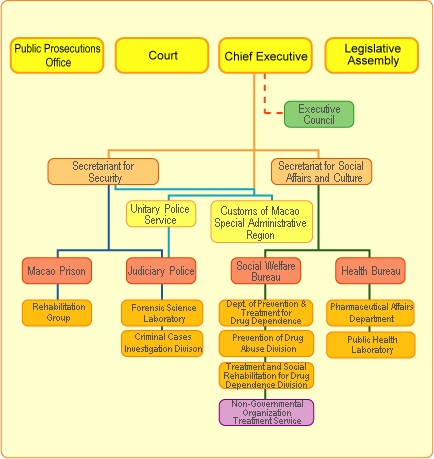
Controlling the supply of drugs and reducing its demand by distribution
of tasks in different organizations, co-operations and combining
public forces, to thoroughly enforce all kinds of anti-drug tactics
have always been the prominent drug control strategies for the
Macao government. The task of combating drug-related crimes and
drug dependence as well as treatment are executed by relevant departments
of the Secretary for Security and the Secretary for Social Affairs
and Culture of the Government of the Macao SAR.
In recent years, the authority has reinforced measures against drug-related
crimes, and continued revising those measures so as to match the
actual situation. The government attaches great concern on the
development of related studies and to external anti-drug co-operations.
|
|
According to statistics of the
Public Prosecutions Office of Macao SAR, 191 drug cases were registered
for investigation in 2004, an increase of 9.8% in comparison with
174 cases in 2003. The total number of prosecutions was 193, approximately
with 197 cases in the preceding year. 106 cases were involved in
drug trafficking, with 42 prosecutions. There were 85 cases of drug
trafficking, trafficking in small amount, trafficking-drug taking
and illegal possession of drugs, with 151 prosecutions in all.
Statistics from Macao Customs has shown a decline in drugs seized
among individual instances in 2004 compared with 2003. Among 114
cases, there were 2,300 tablets of psychotropic pills, a decrease
of 33% compared with the previous year, 20g of ketamine, with 60%
decline and 160 g of cannabis with 26% decrease.
In the same year, the Judiciary Police arrested 270 suspected drug-related
crimes, among them, 73 were suspected with trafficking (there were
45 in 2003), 197 were suspects in illegal drug consumption (there
were 200 in 2003). Drugs seized throughout the year by the Judiciary
Police consisted of: 55g of heroin (87g in 2003), 3000g of cannabis
(970g in 2003), 500g of ketamine (204g in 2003), 231g of cocaine
(4g in 2003) and 1,904.5 tablets of restricted pills (5,585.5 tablets
in 2003). There was a sharp rise in cannabis and cocaine, as well
as an increase of ketamine compared with the year before. However,
heroin and restricted pills declined considerably.
Regarding the statistics of drug dependents in Macao, 692 drug abusers
were registered in 2004 (including 350 voluntary detoxification cases
from official and non-governmental treatment centers, plus 342 drug
addict prisoners, but excluding those being registered repeatedly).
There was an increase in 9.2% compared with 634 drug abusers in 2003,
the growth was mainly due to the increase of drug dependence among
prisoners. In 2004, 86 new cases for treatment were recorded, similar
to that of 2003. Heroin remained the main drug consumed within those
who sought treatment, followed by psychotropic substances and with
almost 80% adult males.
The overall drug problems in Macao remained under control for the
previous years; nevertheless, psychotropic substances consumption
increased constantly. According to the overall evolution in 2004,
the following changes occurred: among new treatment cases, there
were a remarkable increase in females and youngsters. In addition,
drug addicts affected by HIV/AIDS rose dramatically. The authority
has been watching the situation closely, and this gave a bigger incentive
and determination for the government to beat drug-related problems.
|