|
Drug Dependence Prevention and Treatment Work |
||||||
|
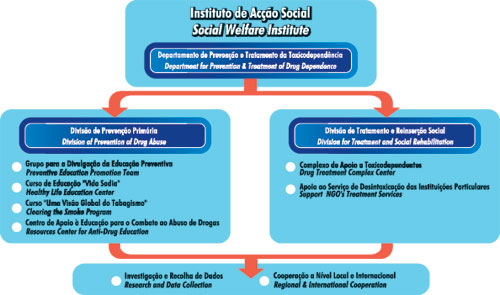
(I) Social Welfare Institute-Department for Prevention and
Treatment of Drug Dependence |
||||||
|
The Department for Prevention and
Treatment of Drug Dependence (DPTDD) of the Social Welfare Institute under the
government of Macao SAR is responsible for the planning and the execution of
anti-drug prevention and treatment work.
Its main scopes are: to implement anti-drug preventive education and
publicity, to provide detoxification and rehabilitation services, to collect
and analyze important materials and data in the drug dependence domain, to
conduct relevant studies, and also to participate in regional and
international co-operation.
2003 was a fruitful year for the
prevention and the treatment of drug dependence work. As for prevention work, the DPTDD of
the Social Welfare Institute inaugurated two new facilities – “The Healthy
Life Education Center” and “Resources Center for Anti-Drug Education” The first
Center allows for the strengthening of the promotion of drug abuse prevention
and health education to children, while the other one focuses on providing
drug control related information and tools to all Macao citizens, in order to
popularize further anti-drug education.
In the same year, a “Narcotics Youth Social Service Award Program" was introduced for the first time. The result was satisfactory. It fulfilled the aims of drug abuse preventive education among youngsters and
motivating non-governmental organizations to become more active in realizing
anti-drug activities. As for
treatment work, the operation of the “ Meanwhile, the Social Welfare
Institute completed several important related studies, of which “The Macao
Tertiary Student and Drug Research” and “The Research of Drug Abuse Situation
among the Youth from Street in Apart from this, during the same
year, the Social Welfare Institute organized different related departments to
support and participate in several major regional seminars and anti-drug
activities. For instance, including “The 2nd Guangdong,
Hong Kong and Macao Conference on Policy to Tackle Drug Abuse and Trafficking”
held in February in Zhong Shan; “The 3rd Hong Kong,
Macao and Mainland Conference on Substance Abuse, Prevention and Treatment”
held in March in the city of Kun Ming of Yun Nan;
“The 7th Meeting on National Substances Dependence” at Urumuqi
of Xin Jiang in
September; “Guangdong, Hong Kong and Macao Joint
Anti-Drug Rally” held in GuangZhao of the 6.26
International Day Against Drug Abuse and Illicit Trafficking and Anti-Drug
Itinerary Exhibition held in ShenZhen in
November. As a whole, in 2003,
exchanges and cooperation had concrete effects on Anti-Drug work in The Division of Prevention of Drug
Abuse and The Division for Treatment and Social Rehabilitation are two
subordinate units of the Department for Prevention and Treatment of Drug Dependence
of Social Welfare Institute, which in charge of all prevention and treatment
work. |
||||||
|
1.
The Division of Prevention of Drug Abuse |
||||||
|
By means of
seminars, exhibitions, training courses and the media, the Division promotes anti-drug
education and propaganda in schools, communities, families, and to people
from different social classes.
The Division also encourages and supports NGO’s to hold anti-drug
prevention events, aimed at rising the general public’s awareness of draug control, enhancing people’s concern and
participation in Macao’s drug control, together building a drug-free
community At present, drug abuse preventive
education in |
||||||
|
|
||||||
|
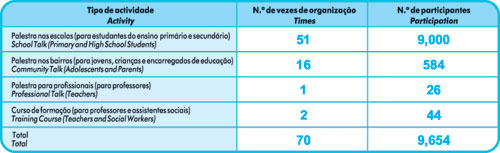
3. Anti-Drug
Talks and training Courses 51 Anti-Drug Talks were held with 9,000
participants from 19 Primary, secondary and College students. Regarding community promotion, 16
Anti-Drug Talks were given to several Non-governmental Organizations. 584 adolescents and parents were
present. In addition, the
Division provides Anti-Drug training programs and talks for professionals
every year; subjects include general substance abuse knowledge, anti-drug
law, the local drug abuse situation, treatment and rehabilitation, as well as
preventive education, and visits to relevant organizations. In 2003, 70 teachers and social
workers participated in the training courses and talks.
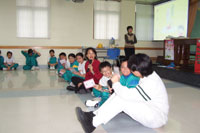
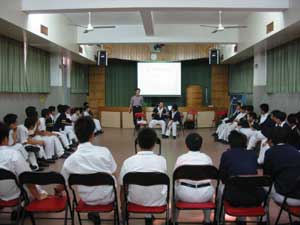
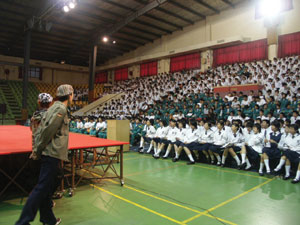
Drug Abuse
Prevention Talk introduced at schools. Statistics
on Anti-Drug Talks and Training Courses in 2003
4.
Inauguration
of the In order to enhance and focus on the
supply of anti-drug related information and teaching materials to the public,
so as to popularize such education. In 2003, the Social Welfare Institute
established "
6. Important
Anti-Drug Events [ The
International Day Against Drug Abuse and Illicit Trafficking ] In response to “International Day
Against Drug Abuse and Illicit Trafficking” on 26th June, as usual, the Social
Welfare Institute collaborates with various officials and non-governmental
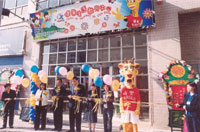
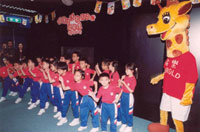
organizations to launch a series of large-scale anti-drug campaigns. On 27th June 2003, the Social
Welfare Institute together with the Macao Sports Development Board and the Education
and Youth Affairs Bureau held a “Summer Vacation Activities Opening and
Anti-Drug Day
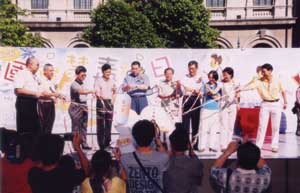
Guests
hosting the Anti-Drug Day Activities Opening Ceremony. On 5th July, the Social Welfare
Institute with the cooperation of more than 10 officials and non-
governmental organizations held an “Anti-Drug Variety Carnival” at the Largo
do Senado, the aim of which was to focus the whole
city’s awareness upon drugs and related problems, to mobilize the population,
especially teenagers, to support and take part in the fight against
drugs. Apart from the fabulous,
formal opening ceremony, game stalls and an anti-drug exhibition were
available. In order to enlarge
the contact with the population, 3 supplementary areas were set up for
different associations to produce street performances. In addition, an outdoor broadcast by Teledifusão de Macao [
Tobacco-Free Activity ] In concordance with the theme of
“Tobacco free film, tobacco free fashion, Action” of the “5.31 World
Tobacco-Free Day” the Social Welfare Institute together with the Health
Bureau, the Civic and Municipal Affairs Bureau and the Cut Audio-Visual
Association organized “No Smoking, In Fun DV Video Production Program” for
the purpose of enhancing teenagers’ awareness of tobacco damage. Under the instructions of qualified
video and film making tutors to enable participants to develop their
imaginations, working together to produce a short anti-smoking promotion film
for youngsters in
“World
No-Tobacco Day” Activity - Youth DV Video Production. During the month of May, a series
of promotions diffused related messages through broadcasting station on the
effects of smoking and the harmfulness of second-hand smoke. In various districts of Macao, Taipa and Coloane banners and
light box of “No Smoke, In Image” were displayed to draw the public’s
attention to the issue of smoking, thus, together building a tobacco-free
environment. [ Sunny
Youth Activity ]
“Positive
Life, Say No to Drugs”; adolescents participating in Substance Abuse
prevention activity. In 2003, the Social Welfare
Institute for the first time collaborated with the Education and Youth Affairs
Bureau and the Macao Sports Development Board, as well as non-governmental
organization Sin Meng Charity Association to
realize the “Sunny Youth-Social Service Award Program”, with the theme of
“Positive Life, Say NO to Drugs”.
Through a series of activities, youngsters were made aware of the
damage of drugs and a message of positive life was promoted. Various activities included an
Anti-Drug Poster Design Competition, Anti-Drug Slogan Competition and Sports
Competition with variety show.
The first two competitions used a new voting mode by sending SMS
messages, so as to involve the participation of the public, therefore
increasing their anti-drug concern.
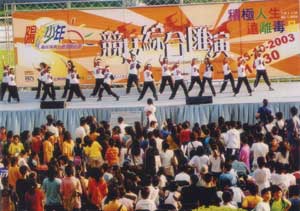
The winning works of the two competitions were shown at the The final activity of “Sunny
Youth” was a sports competition with variety show, which held on 25th October
at the Macao Jockey Club. About
5,000 teenagers attended. 7.
Development of diversified Anti-Drug Activities According to statistics of the
Division of Prevention of Drug Abuse in consecutive years, participants in
preventive education mostly were schoolchildren and adolescents. The majority of such activities were
led by the government. In order
to motivate the population, reinforce community preventive education and
develop diversified anti-drug activities towards youngsters. In 2003, the Social Welfare Institute
introduced two new prevention projects - “The Narcotics Youth Social Service
Award Program” and “The Anti-Drug Drama Barnstorm”. The projects’ operations were as
follows: [ Narcotics
Youth Social Service Award Program ] The project was officially
launched in October 2002 with the aim of mobilizing more youngsters to
organize different anti-drug education activities and support-related
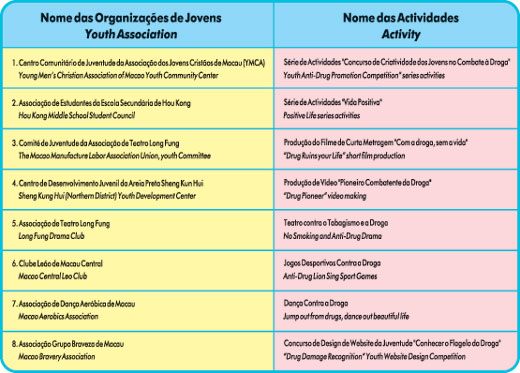
works. 8 Youth Associations
participated in the project of 2003.
Various activities were held and each had its own particular themes which
included video making, drama, dancing, sport, web page design, 4-box comics,
posters, song lyrics, and entertaining events. The above activities attracted the
participation of more than 3,500 teenagers. The entire project fully demonstrated
their creativity and team spirit, inciting them to commit themselves to the
preventive anti-drug mission, thereby bringing more practical materials on
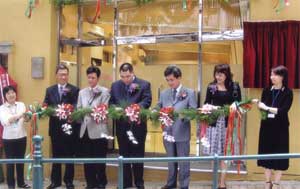
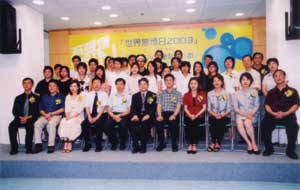
related work, as well as to young partners. On 2nd April 2004, the Social Welfare
Institute held an exhibition and trophy ceremony of the “Narcotics Youth
Social Service Award Program” at
Teenagers
participate in “Narcotics Youth Social Service Award Program” Activities
organized by various Associations [
Anti-Drug Drama Barnstorm ]
Theatre Farmers Anti-Drug Drama Barnstorm On behalf of the Social Welfare
Institute, the 8. Mobilize
Non-Governmental Drug Control Activities By means of technical and
financial support, the Social Welfare Institute gives incentive to mobilize
Non-Governmental Associations take part in the development of Anti-Drug
prevention work within the community. In 2003, the Social Welfare
Institute granted $234,200 patacas to five
Associations to hold more than ten activities, with predominant topics being
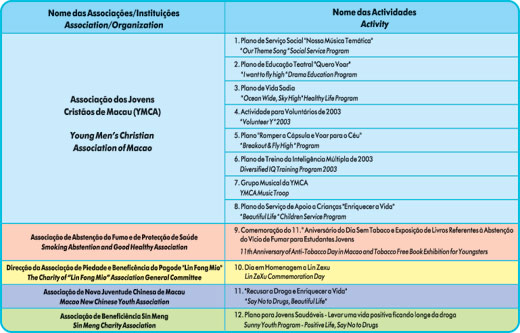
anti-drug prevention, anti-smoking and the development of adolescents. Activities organized by
various Associations
Besides, in 2003 the Social
Welfare Institute maintained substantial financing to the “Young Men’s
Christian Association of Macao” for the support of the operation and
development of its “Youth Community Center” located at Ilha
Verde. Facilities of the Center
include several function rooms such as a multi-purpose activity room, an
Audio-Video room (Karaoke), a Band room, a Computer room, a Dancing room and
a Conference room, etc. The service target is to provide preventive and
developmental activities to youngsters aged from 10-24. The Center also has an obligation to
spread the Anti-Drug message. In 2003, there were 1,213
effective members of the center, while frequency of attendance reached 30,872
throughout the year. Activities
held in the same year included the Prevention of Drug Abuse Promotion
Competition, Anti-Drug Knowledge Talks, visits, trainings of volunteer
workers, adventure counseling series, and music and drama art works, with
more than 224 types of activities with the participation of 32,927
persons/times |
||||||

|
2.
The Division for Treatment and Social Rehabilitation |
||||
|
|
||||
Regarding support for NGO drug
treatment services, the Social Welfare Institute financed the construction of
a “Teen Challenge” Furthermore, in 2003,
when |
||||
|
1. [ Cases
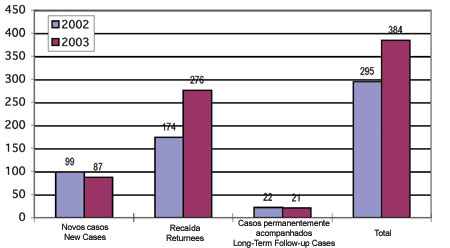
recorded by outpatients' clinic: ] In 2003, the outpatients' clinic
followed up 384 voluntary detoxifications. 87 were new cases, 276 were returnees
and 21 were long-term cases. The
total number of followed-up cases increased 30% compared with that of 2002
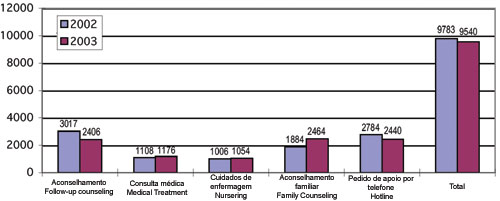
(chart 1), while the total number of services provided reached 9,540, almost
the same number as for the previous year (chart 2). [ Medical
Diagnosis and Treatment: ] 3,700 drug urine tests were
carried out in 2003 and this accounted for a 44% increase compared with
2002. As for drug abuse
diagnosis, apart from traditional drug tests, MDMA ecstasy, cannabis and
alcohol solutions were purchased, as well as alcohol breath tubes to
reinforce the checking of a further variety of abused substances. For infectious diseases body checks, in
2003, 289 body check and infectious diseases diagnoses were carried out for
drug treatment patients and related staff. The number of people examined was the
highest ever. It increases the opportunity of examination for those who seek
drug treatment, therefore to control effectively the proliferation of
infectious diseases among these people, especially the transmission of
AIDS. In 2003, the contamination
of total examined cases was as follows: hepatitis B and C was almost the same
as before, however, hepatitis C infection still accounted for 73%. An
alarming situation occurred in the same year with one confirm case of AIDS
and one suspected case. The risk
of HIV contamination among drug takers is rather worrying. On the strength of the circumstance,
the clinic launches relevant publicity, apply harm-reduction measures by
inculcating knowledge and methods of precaution and treatment about
infectious diseases to patients, propagating messages of hazardous syringe sharing
and unsafe sex and also providing free condoms to outpatients. [
Psychosocial Intervention and Rehabilitation Work: ] In 2003, social workers provided
2,406 examples of psychosocial assistance and 2,464 examples of family
assistance to outpatients, a total of 4,870 persons/times. Psychological counseling declined when
compared with the previous year, whereas family interventions increased. The Social Welfare Institute will also
provide necessary and temporary financial support for those in a precarious
situation. The Division for Drug
Treatment and Social Rehabilitation followed up an average of about 30
subvention cases per month. [ Primary
Detoxification Service: ] In 2003, 138 persons/times for
detoxification were recorded by the Primary Detoxification Unit, comprising
115 males and 23 females. Ages
ranged from 35-39. There was a
high increase in treated cases compared with 2002. Regarding operational aspects,
inpatient services increased several measures in order to optimize the
treatment quality, and meanwhile, carried out assessments with different
services, amended internal operation rules when needed, for instance, through
the award planning, drug treatment and rehabilitation co-workers plan, as
well as introducing “Therapeutic Community” models to consolidate
hospitalization. Besides, the inpatient clinic
adjusted the procedure of case referral to increase co-operation with NGO's,
so that more patients after completing treatment could participate in the
related NGO rehabilitation programs.
The Social Welfare Institute also, through “Macao Renovation and
Mutual Assistance Association” referred ex-addicts to work partially in the [
Development on Medical Trail: ] In early 2003, the Therapy
provided by Division for Treatment and Social Rehabilitation 2002-2003
Chart 1. The number of new cases registered is
less than 2003. Moreover, there
is a high increase in returnees.
Therefore, the total number has increased of 30% compared with 2002.
No. of
Services by Outpatients' clinic 2002-2003
Chart 2. The total number of outpatient
services provided is similar to that of 2002. Due to cases related to family
problems increasing lately, the Social Welfare Institute has strengthened the
relevant work. Because of the
shortage of man power, cases intervention in general has to be reduced. 2. Development and Support
to Non-Governmental Treatment Services In 2003, the Social Welfare
Institute subsidized four non-governmental organizations, consisting of four
detoxification dormitories, one rehabilitation midway residence, one outreach
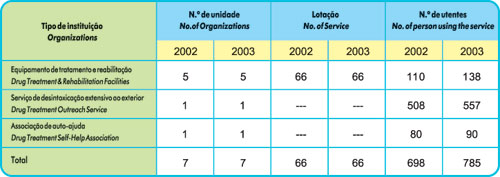
drug treatment service and one mutual assistance association. The total amount of usage of the
above-mentioned services was 785 persons/times. (See chart below) Non-governmental
Organizations receiving subvention 2002-2003
In recent years, the Social
Welfare Institute has constantly evaluated and adjusted financial support to
drug treatment organizations for the purpose of improving and optimizing the
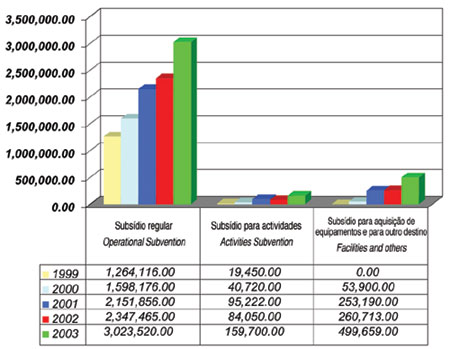
quality of related services and proper development. In 2003, there was an increase
compared with that of 2002, either in fixed financial support, facilities and
other subsidies. The increase is
due to the sponsoring of institutes for the recruitment of competent social
workers, the acquisition of recreational equipment, the rebuilding of a
female drug treatment center and especially to related organizations for the
development of SARS preventive measures and campaigns.
Financial
support of Social Welfare Institute to non-governmental drug treatment
service statistics in recent years [
Substantial support to Non-Governmental Organizations/Associations Drug
Treatment in 2003: ] In order to optimize the quality
of services and the effectiveness of drug treatment organizations, in 2003,
the Social Welfare Institute subsidized relevant organizations and
associations to hold 37 drug treatment and rehabilitation activities. As well, it financed the purchase of
equipment for those centers, and the reinforcement in health and prevention
measures, the holding of regular meetings with all concerned parties,
together to combat SARS. Due to the development of the Christian
New Life Fellowship in In the second half year of 2003,
the Division for Treatment and Social Rehabilitation began giving assistance
to the center's outreach services to contact youngsters with drug abuse,
through co-operation exploring the drug abuse situation of Macao
Renovation and Mutual Assistance Association: In 2003, The Division for
Treatment and Social Rehabilitation provided assistance to the Association in
hiring social workers and with professional training development, as well as
with the setting up of an administrative regulatory system with accounting
expertise, in order to optimize the overall management and development
capacity of the Association.
Besides, the Social Welfare Institute continues to collaborate with
the Association on the co-worker program, which provides constant and
practical working opportunity for ex-addicts, together to improve the work
that after drug treatment recovery. 3. Other
Special Tasks and Activities of the Division for Treatment and Social
Rehabilitation
* On 22nd August 2003,
in collaboration with “The Association of Rehabilitation of Drug Abusers of
Macao” to hold a “Activity of summer season gathering for ex-addicts and
their family members” so as to enlarge communication and cooperation between
non-governmental drug treatment organizations. As well, the aim was to motivate
inpatients, ex-addicts and their families to take part in more healthy
activities and support jointly drug treatment and rehabilitation work. * To ensure the staff's
awareness of fire prevention, The Drug Treatment Complex Center with the
assistance of Fire Brigade, held a fire drill course, on 5th August an
on-site fire drill was conducted, together with the personnel of Fire
Brigade, so as to establish an effective procedure for emergency escape and
the evacuation the inmates. * So as to mobilize and
support the in-service training for staff of NGO, optimizing the
professionalism of drug treatment, in 2003, The Division for Treatment and
Social Rehabilitation provided the following training courses for those
organizations: (a) Drug Treatment workers Elementary
Course (Second Term)
(b) SARS
Prevention Talk In order to prevent effectively
the advent of SARS, during March and April 2003, three talks were given by
doctors and social workers from The Division for Treatment and Social
Rehabilitation to related organizations.
Topics mainly included the causes and symptoms of SARS, transmission
methods, prevention methods, counseling and the application of preventive
works. The total number in
attendance was 70. Besides,
inspections were held on the situation of prevention on eight related
premises to provide necessary technical assistance and emphasize the notion
of infectious disease prevention for the staff and inmates of NGO drug
treatment premises and to ensure that the equipment and environment met the
standard. (c) Drug Treatment Related Social Workers
Professional Training Course The course was held from November
to December 2003, with discussion of International and Macao SAR drug control
mechanism and law, the causes of addiction and drug effects, the different
modes of detoxification guidance, motivation discussions, propagation methods
and skills on harm reduction, therapeutic, community method and application,
experience exchange/case sharing, the handling of emotions and decompression
prescriptions. Thirteen persons
attended the program, and apart from enriching drug treatment social workers'
expertise, it also enlarged experience exchange and co-operation among them. (d) Prevalent Drugs Talk On 13th November 2003, the Social
Welfare Institute invited an expert chemist from The Forensic Laboratory of
Judicial Police as a guest host.
Topics of the talk included the varieties and consumption methods of
prevalent drugs in |